

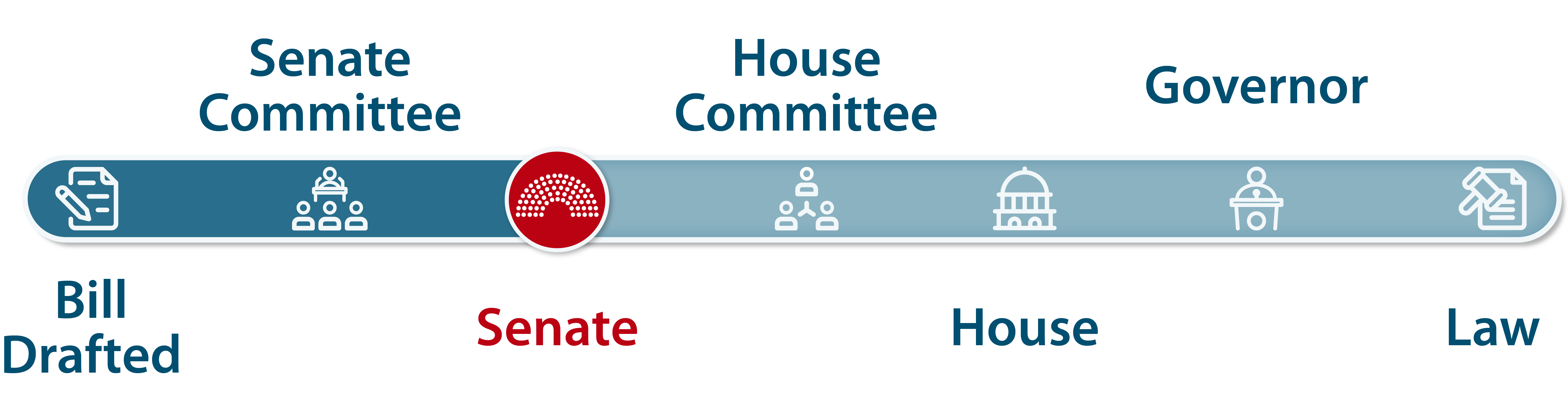
Latest Updates
March 14 | Section 5 Removed from S.B. 6
The Appropriations Committee removed Section 5 from S.B. 6. This bill no longer directly impacts homeschool families. HSLDA is now neutral on S.B. 6.
Thank you for calling and emailing your representatives about this bill.
Mar. 5 | Bill amended in committee; sent to Senate floor
S.B. 6 was discussed further in a committee hearing on March 5, where they voted to amend the bill and send it to the Senate floor. This amendment would require DCF to destroy the records of families reported to them due to withdraw, who have been connected to DCF in the past. We still have concerns that this bill incorrectly presumes a family is guilty until proven innocent when they go to withdraw their child.
Please contact your Senator and ask them to remove Section 5 of S.B. 6.
Mar. 3 | Bill heard in committee
S.B. 6 was heard in the Committee on Children on March 3, but it was not voted on.
Feb. 27 | Bill will have a public hearing on March 3
SB 6 was introduced by the Joint Committee on Children on February 4 and was drafted in committee on February 27. It is scheduled for a public hearing on March 3.
Ways you can take action:
1. Testify at the public hearing or attend in person.
Individuals may sign up in person to testify beginning at 12:00 p.m. in the LOB atrium. Sign-up is first come, first served. Regardless of whether you are able to testify, we encourage you to come to the hearing.
Tuesday, March 3 at 1:00 p.m
Room 2E, Legislative Office Building (LOB)
2. Submit written testimony.
Written testimony may be submitted through the General Assembly’s website. Please include the bill number (SB 6) in the subject line and your full name. Submitted testimony becomes public record.
Keep your testimony brief and focused. A simple request to amend S.B. 6 by removing Section 5 is effective.
3. Contact members of the Committee on Children.
Respectfully ask them to amend SB 6 by removing Section 5.
If your own legislator serves on the Committee, it is especially important that you contact them. To see whether your legislator is on the committee, view the full list of committee members here. (Not sure who your legislator is? Find your legislators here.)
If your legislator is not on the committee, please reach out to the Co-Chairs and Vice-Chairs of the committee.
- Co-Chair Corey Paris (Email: corey.paris@cga.ct.gov / Phone: 860.240.0464)
- Co-Chair Ceci Maher (Email: maher@senatedems.ct.gov / Phone: 860.240.0068)
- Vice Chair Mary Welander (Email: mary.welander@cga.ct.gov / Phone: 860.240.8556)
- Vice Chair Christine Cohen (Email: cohen@senatedems.ct.gov / Phone: 860.240.0455)
Summary of SB 6
Senate Bill 6 is a broad child protection and family support measure. HSLDA supports meaningful reforms that strengthen the state’s ability to protect children from abuse and neglect. Sections 3 and 4 provide constructive tools to improve coordination and accountability within the child welfare system.
Section 5, however, is overbroad and creates a new statutory reporting structure unrelated to the core reforms of the bill. Among other things, Section 5 would imperil homeschool freedom in the state.
What Section 5 Requires
Section 5 mandates that:
- When a child is withdrawn from public school pursuant to C.G.S. § 10-184, the local board of education must notify the Commissioner of Education within two business days.
- The Commissioner of Education must then notify the Commissioner of Children and Families within two business days.
- DCF must determine whether the child is under protective supervision or receiving protective services and, if so, note the withdrawal in the child’s case file.
Although described as informational, this provision establishes a mandatory cross-agency reporting pipeline that does not currently exist in statute.
Why Section 5 Is Problematic
Section 5 applies to every public school withdrawal, regardless of the reason. This includes families who withdraw to homeschool, transfer to private school, relocate, or address personal or medical needs.
By sweeping all withdrawals into a state-level reporting mechanism that triggers DCF review, Section 5 unnecessarily implicates law-abiding families exercising lawful educational choices without reasonable suspicion that they have done anything wrong.
Connecticut has long respected parental authority and has not imposed statutory registration or reporting requirements on homeschool families. Section 5 would effectively formalize a withdrawal-tracking system that routes homeschooling decisions through state and child welfare channels.
This risks creating a chilling effect on families considering homeschooling and unfairly establishes an implicit presumption of suspicion and it could prevent parents from making necessary and timely decisions for a child’s wellbeing.
Constitutional and Policy Concerns
Parents possess a fundamental right to direct the upbringing and education of their children. Legislative measures that burden that right must be narrowly tailored to address demonstrated concerns.
Section 5 is not narrowly tailored. It does not limit reporting to situations involving substantiated abuse or neglect. Instead, it broadly subjects all withdrawing families to a new reporting framework.
Child protection reform should be targeted and evidence-based. Overbroad reporting mandates do not directly address the root causes of abuse and may undermine constitutional protections.
It is a bedrock principle of U.S. law that parents are presumed to act in the best interests of their children unless proven otherwise. Homeschooling families deserve to be treated with fairness, respect, and the presumption of innocence.
Connecticut can strengthen DCF while preserving longstanding respect for parental rights. HSLDA supports SB 6’s constructive reforms and respectfully urges the Committee to amend the bill by removing Section 5.