

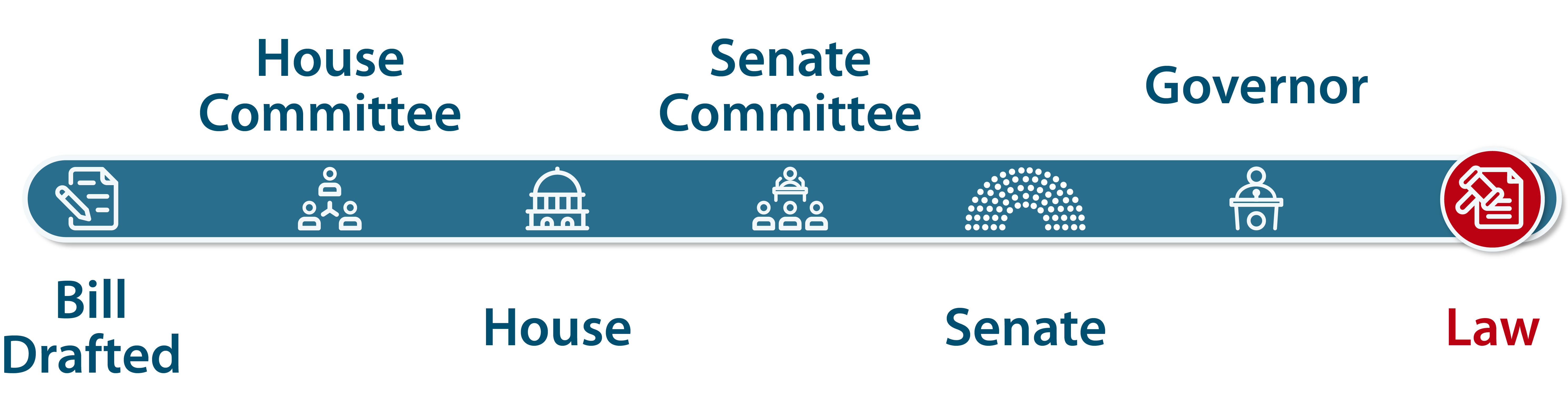
Latest Updates
May 26 | Signed by the Governor
H.B. 5468 was signed by Governor Ned Lamont on May 26, 2026
Some portions of this bill will go into effect on July 1, 2027, with others following at a later date. We will update our website as these changes go into effect.
May 5 | Passed the Senate, Headed to the Governor
H.B. 5468 passed the Senate on May 4 by a vote of 22-14.
The bill will now be sent to Governor Ned Lamont’s desk. Please call (860) 566-4840 and email Governor Lamont and ask him to veto this bill.
May 4 | Placed on Senate Calendar
H.B. 5468 has been placed on the Senate Calendar.
Click here to contact your state senator immediately and urge them to vote no on H.B. 5468. We also encourage you to come to the capitol to show your opposition to this bill.
April 29 | Senate vote expected soon. HSLDA hosting press conference
H.B. 5468 could be voted on by the Senate very soon. Please consider taking these actions to stop this legislation:
- Contact your State Senator today. Call or email and urge them to oppose H.B. 5468. Be respectful and clear: this bill would require government approval before a family may begin homeschooling, and it uses an unreliable and over broad registry to block families who have done nothing wrong. You can find your Senator here.
- Share this Memo. HSLDA’s General Counsel drafted a detailed memo raising constitutional concerns with this bill. If you can get it in front of your Senator or their staff, please do. It lays out the constitutional problems in plain terms.
- Join us tomorrow, April 30, at 10 a.m. HSLDA Attorney Ralph Rodriguez, TEACH-CT, and other homeschool advocates are holding a press conference at the Legislative Office Building, Room 1B, 300 Capitol Ave, Hartford, CT 06106. Come if you can. Show up. Be counted.
Apr. 24 | Passed House
H.B. 5468 has passed the House as amended by LCO 4428. The bill now moves to the Senate for consideration.
While the House removed the portfolio and assessment requirements, the bill continues to impose significant new requirements. It should not be viewed as a favorable outcome based on that change alone.
The bill creates a universal, annual intent to educate requirement for all families with children ages 5–18, requiring parents to declare whether their child will attend public school, a nonpublic school, or receive “parent-managed learning.” There is no grandfathering once this takes effect.
Parents must still appear in person to withdraw a child from public school. Most significantly, the bill requires a mandatory DCF records check before a child may be withdrawn for homeschooling. This review applies to all adults in the household and includes both registry status and ongoing investigations. The withdrawal is not effective until this process is complete and may be denied based on the results.
Action Needed:
- Contact your state senator and urge them to oppose H.B. 5468 (LCO 4428).
- Contact the Governor’s office and ask that this bill not be signed into law.
- Visit the Capitol to demonstrate your opposition. The Senate is scheduled to meet April 28, April 29, and May 1.
Time is short as the legislative session is set to adjourn May 6.
Apr. 18 | Amendments Proposed, Vote Expected Soon
H.B. 5468 has advanced out of the Appropriations Committee in its prior form, as passed by the Joint Committee on Education. In addition, lawmakers have introduced a proposed substitute amendment, LCO 4221, which has not yet been adopted but may be called for a vote on the House floor.
Amendment LCO 4221 removes the annual portfolio requirements, but includes some concerning changes:
- Requires a DCF records check for every adult in the home
- Includes individuals under investigation, not just substantiated cases
- Allows the state to block a family from homeschooling
- Adds enforcement through school district reporting to the DOE
- Still requires families to retain records under state guidance
- Redefines homeschooling as “parent-managed learning”
There is still time to stop this legislation. Please reach out to your representative and respectfully ask them to oppose H.B. 5468 in any form.
Mar. 18 | Bill passed by House Education Committee
H.B. 5468 was voted out of the Joint Education Committee by a narrow margin of 6 votes. It will now move to the full House of Representatives.
Thank you to everyone who engaged on House Bill 5468—whether by testifying, submitting written comments, or contacting your legislators. Your efforts made a real impact and ensured that lawmakers heard directly from the families affected by this bill.
While this is not the outcome we were hoping for at this stage, it is important to remember: The process is not over. Your voice matters at every stage of this process! Legislators are paying attention, and your outreach will make a difference as this bill moves forward.
There is still time to stop this legislation. Please reach out to your representative and respectfully ask them to oppose H.B. 5468.
Mar. 17 | Bill to be voted on March 18 @ 10 a.m.
We have just received word that CT HB 5468 will be voted on at 10 a.m. on March 18 by the House Education Committee. Here's what you can do:
- Respectfully ask your legislators to vote no. (Find members of the committee here).
- If you are able, please come to the Legislative Office Building at 10:00 am to show your support of homeschool freedom: Room 1D, 300 Capitol Avenue Hartford, CT 06106
- Watch the hearing
Mar. 12 | Bill heard in committee; waiting on a vote
The public hearing on H.B. 5468 began at 10:15 a.m. on March 11 and lasted nearly 19 hours, with hundreds of parents, students, educators, and advocates testifying. An overwhelming number of speakers voiced serious concerns about the bill and the impact it would have on homeschooling families across the state.
We want to express our sincere gratitude to the many homeschool families who took the time to travel, wait for hours, and testify. Your voices mattered. Legislators heard directly from the families who would be affected by this proposal, and your thoughtful testimony helped highlight the real-world consequences of expanding government oversight of home education.
We are also grateful to the over 3,000 people who submitted written testimony, and the many who followed the hearing online.
While the hearing has concluded, the process is not over. Members of the Education Committee will now consider the testimony they received before deciding whether to advance H.B. 5468.
Your continued engagement is vital:
1. Contact your legislators
Please respectfully ask your state senator and state representative to oppose H.B. 5468, regardless of whether they are on the Education Committee.
Let them know that:
- Homeschool families should not be subjected to unnecessary regulatory oversight.
- Connecticut’s current framework already allows the state to intervene when legitimate concerns arise.
- Reforms aimed at protecting children should focus on strengthening the child protection system rather than regulating families who are lawfully educating their children.
In particular, you can contact the chairs of the Education Committee:
- Co-Chair Sen. Doug McCrory (Email: mccrory@senatedems.ct.gov / Phone: 860.240.1453)
- Co-Chair Rep. Jennifer Leeper (Email: jennifer.leeper@cga.ct.gov / Phone: 860.240.8753)
- Vice Chair Rep. Kevin Brown (Email: kevin.brown@cga.ct.gov / Phone: 860.240.8466)
- Vice Chair Sen. Gary Winfield (Email: winfield@senatedems.ct.gov / Phone: 860.240.0475)
2. Thank legislators who raised concerns
If your legislator expressed concerns about the bill during the hearing, take a moment to thank them. Encouragement from constituents helps reinforce thoughtful leadership.
We will continue monitoring developments and will keep you informed about next steps. If the bill advances, additional action will be needed.
Mar. 5 | Bill waiting to be scheduled for a hearing
H.B. 5468 was introduced on March 5 by the Joint Committee on Education and is scheduled to be heard on March 11. Watch the committee hearing here.
Two ways to take action:
1. Attend the hearing or give written testimony (see details)
If possible, plan to attend the hearing on March 11 at 10:15 a.m. in opposition to H.B. 5468. Review helpful tips for attending a public hearing from our friends at TEACH CT.
Room 1E
Legislative Office Building
300 Capitol Avenue Hartford, CT 06106
You can submit written testimony against H.B. 5468 or you can register to speak and give verbal testimony during the hearing (in person or over Zoom).
2. Contact your legislators (see details)
Please contact the members of the Education Committee to ask them to vote no on H.B. 5468. Include a few reasons why you oppose the various oversight mechanisms on homeschool families presented in the bill.
If your legislator is on the Education Committee, it is particularly helpful to contact them. (Not sure who your legislator is? You can find them here.)
If your legislator is not on the committee, please reach out to the Co-Chairs and Vice-Chairs of the committee.
- Co-Chair Sen. Doug McCrory (Email: mccrory@senatedems.ct.gov / Phone: 860.240.1453)
- Co-Chair Rep. Jennifer Leeper (Email: jennifer.leeper@cga.ct.gov / Phone: 860.240.8753)
- Vice Chair Rep. Kevin Brown (Email: kevin.brown@cga.ct.gov / Phone: 860.240.8466)
- Vice Chair Sen. Gary Winfield (Email: winfield@senatedems.ct.gov / Phone: 860.240.0475)
Watch a brief video update from Ralph Rodriguez.
Summary of H.B. 5468
House Bill 5468 as amended by the House would drastically expand government oversight of homeschooling in Connecticut. The bill would require all families to file an annual notice of intent. It would also (a) subject all families who are withdrawing their child from public school to a mandatory waiting period so that the Department of Children and Family (DCF) can conduct a check of the child abuse and neglect registry, and (b) bar any families from homeschooling if any adult in the home is involved in an open DCF investigation or on the registry, regardless of whether the allegations are serious (or true) and without any option to appeal that determination. Together, these changes would establish a system of registration, reporting, and government oversight of homeschooling that Connecticut law has historically avoided.
What H.B. 5468 as Amended by the House Requires
House Bill 5468 as amended by the House would establish a new statutory framework governing families who provide “parent-managed learning” (previously ”equivalent instruction”), commonly known as homeschooling. H.B. 5468 as amended would:
- Require all parents to file an annual notice of intent for students ages 5-18 stating whether their child will attend a public school, a nonpublic school, or receive “parent-managed learning.”
- Remove the portfolio and assessment requirements from the previous version of the bill.
- Require parents to appear in person to withdraw a child from public school and pass a child abuse and neglect registry check through the Department of Children and Family (DCF). The child cannot be withdrawn until this registry check is completed. If a parent appears on the registry for any reason, the family cannot homeschool. The registry includes not just confirmed abuse, but a wide range of “neglect” findings, some of which are minor, disputed, or entirely unrelated to a parent’s ability to educate their child.
- Prevents a family from homeschooling that shares a household with someone who has an open DCF case—even if the case has not been substantiated.
Why HB 5468 as Amended by the House is Problematic
Connecticut has long trusted parents to direct their children’s education without unnecessary government interference. H.B. 5468 would represent a major shift away from that approach.
Connecticut law currently affords parents the freedom to provide home education without annual filings or government involvement. H.B. 5468 would mandate an annual notice of intent and place homeschooling families under a system of ongoing government oversight and scrutiny. Additionally, it would require that families seeking to withdrawal their student to homeschool be checked against the DCF registry.
The registry includes not just confirmed abuse, but a wide range of “neglect” findings, some of which are minor, disputed, or entirely unrelated to a parent’s ability to educate their child.
The bill also bars homeschooling for any family that shares a household with someone who has an open DCF case—even if the case has not been substantiated.
This expansion sweeps in an enormous number of families. Research cited by the National Coalition for Child Protection Reform shows that 25% of all Connecticut children, 34% of Hispanic children, and 42% of Black children will, at some point in their lives, live in a household with an open DCF case—overwhelmingly because of reports later found to be false or unsubstantiated.
Connecticut’s definition of “neglect” is broad and subjective. A parent can be placed on the DCF registry if a caseworker has “reasonable cause to believe” a child was neglected—a standard well below even the preponderance of evidence threshold used in civil court.
Our litigation counsel has reviewed the bill and concluded that it raises serious constitutional concerns under both the Due Process Clause and the Free Exercise Clause of the First Amendment.
Parents should not be treated as though they require government supervision simply because they have chosen to educate their children at home. Policies that broadly regulate all homeschooling families must be met with zealous opposition.
For more information on our concern about this bill, check out our general counsel’s memo.
Conclusion
H.B. 5468 would fundamentally change Connecticut’s longstanding approach to homeschooling by replacing trust in parents with a system of registration, reporting, and government oversight. Lawmakers should reject this bill and preserve the freedom Connecticut families have long relied on to direct their children’s education.