

Hawaii homeschool student Jodi-Lynn Ayers-Kawakami did everything right: straight-A’s, clear goals, timely college application. But when she applied to the University of Hawaii at Hilo last fall hoping to earn scholarships to help pay for her studies in pre-veterinary medicine, admissions officers told her she didn’t qualify for one reason: She is homeschooled.
The denial came as a severe disappointment for the high school senior, who has invested years of work pursuing her dream of helping and healing animals.
Jodi-Lynn’s parents contacted HSLDA for assistance, and our legal team quickly demonstrated to university officials that their decision was based on outdated information.
“Once we clarified what the law says, they were very prompt in saying they would correct not just their message to our members, but the university’s scholarship policy in general,” said Peter Kamakawiwoole, HSLDA’s litigation director and a Hawaii homeschool graduate himself. “We appreciate their responsiveness in clearing up what was really just a misunderstanding.”
Special Skills
Jodi-Lynn and her three younger siblings have been homeschooled since kindergarten.
Jeanette Ayers-Kawakami, Jodi-Lynn’s mother, said homeschooling has helped her children flourish both academically and socially. The siblings stay busy with sports and other activities.
Jodi-Lynn’s interests go further. Alongside martial arts and horseback riding, she trained in horseshoeing—a specialized skill that took her to California for 2 months at age 16. While attending the Pacific Coast Horseshoeing School, she learned to work a forge, hammer red-hot metal into shoes, and then mount the shoes onto the hooves of a fully grown horse. (She also learned to care for the hooves of goats, donkeys, and miniature donkeys.)
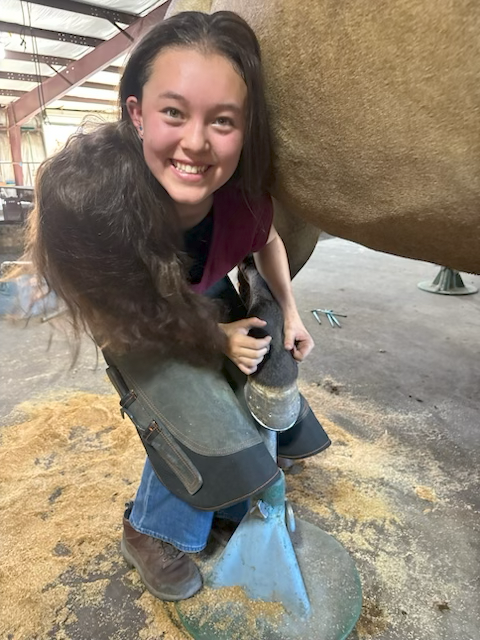
Jodi-Lynn Ayers-Kawakami wears protective gear as she shoes one of the horses at the family farm. (Photo courtesy of the family)
“They were so impressed,” said Jeanette, recalling the reaction of her daughter’s instructors and classmates. “Here’s this petite teen, pumping bellows and hammering away at an anvil. They weren’t sure she could do it at first.”
Since then, Jodi-Lynn has helped shoe the horses at the family’s ranch on the Big Island of Hawaii. Her love of animals has motivated her to pursue studies in veterinary medicine. She’s augmented her existing skills by taking online college courses; she expects to have earned more than 40 credit hours by the time she finishes high school.
Making a Difference
Jodi-Lynn had hoped these achievements would qualify her for merit-based scholarships at University of Hawaii’s Hilo campus. To be told (mistakenly) that her status as a homeschooled student barred her from even the chance to compete for scholarships proved especially distressing to the teen and her parents.
“My gut kept telling me: ‘This just can’t be right,’” Jeanette said. Her instinct was confirmed when she checked the state’s homeschool laws. So she decided to contact HSLDA.
Kamakawiwoole reached out to university officials on the family’s behalf, explaining that state law recognizes homeschooling, and that any resident who completes their parents’ educational program counts as a bona fide Hawaii high school graduate. Kamakawiwoole also informed them that federal law considers homeschool graduates eligible to file for student aid—a recognition that should also apply on the state level.
After receiving this information, the university quickly responded to the Ayers-Kawakami family to say Jodi-Lynn was welcome to apply for scholarships.
“We’re so grateful for HSLDA’s help,” said Jeannette.
“And we’re happy to have been of assistance,” noted Kamakawiwoole. “While bills to regulate homeschooling or landmark cases that set major precedents tend to grab the spotlight, much of the work we do involves helping individual families with discrimination or difficulties. While those situations may seem small, they make a huge difference to homeschooled students, especially graduates who want to engage in further study, follow their dreams, and give back to their communities.”