

There is a lot happening these days in the world of education choice. And, as is often the case when a lot is happening at once, some very different things are getting lumped together.
Education savings accounts. Tax credits. Scholarship Granting Organizations (SGOs)—they are not all the same.
Understanding the differences between them should come before support or opposition.
For HSLDA, our starting point is simple: We believe homeschooling should remain private. Parents, not government, should be responsible for directing their children's education. So when we look at proposals intended to help families afford private education, one of our first questions is, “What does this proposal mean for the independence of homeschooling?”
This concern is not new—for HSLDA or for me.
In 2017, I gave a speech to an assembly of homeschool leaders at the Museum of the Bible called “The Civic Virtue of Private Home Education.” It later became a printed piece that, over the years, has been distributed to hundreds—perhaps thousands—of legislators and other policymakers.
My argument hasn’t changed.
Homeschooling wasn't built by government. It wasn't the product of a federal program, a state appropriation, or the foresight of some education bureaucracy. Moms and dads built it. They formed co-ops, support groups, state organizations, sports leagues, curriculum companies, legal organizations, and thousands of other private associations.
Through these efforts, little by little, homeschooling families established something remarkable.
And, when those early homeschooling families went to their legislators, they weren't saying, “Please give us some money.” They were saying, “Please leave us alone.”
Nearly a decade later, I still believe that. And that principle helps explain why HSLDA can oppose one kind of education benefit while supporting another.
ESAs: The Government Looking Over Your Shoulder
Let's start with education savings accounts, or ESAs.
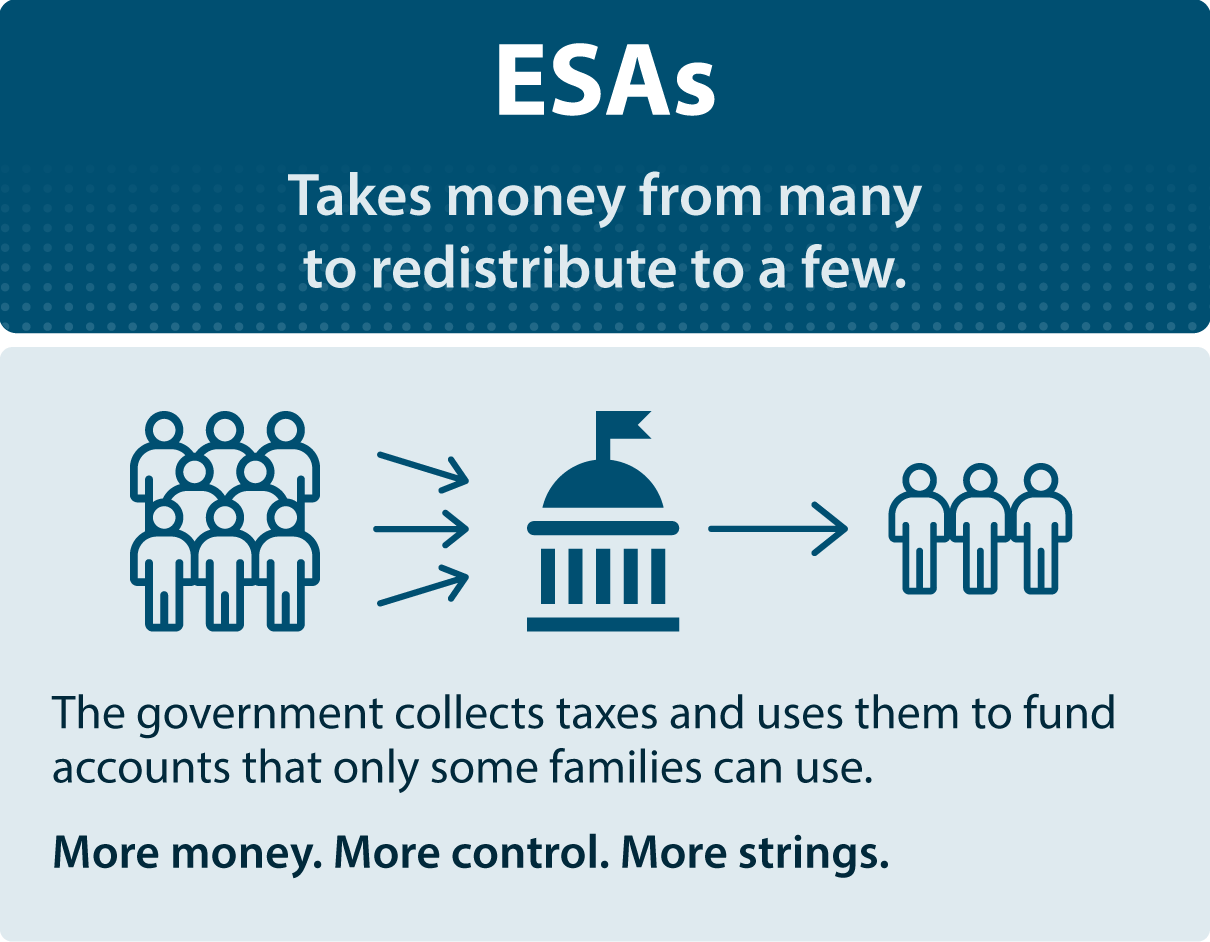
The details vary from state to state, but the basic idea doesn’t vary much at all. Government collects taxes. A portion of that money is then made available for families to pay for approved educational expenses for their children.
These are not really “savings accounts.” That name masks what they really are—a way to redistribute tax money collected from all taxpayers to benefit parents of school-age children.
For families, the attraction is obvious. Education costs money. An ESA can provide thousands of dollars for curriculum, tutoring, classes, private school tuition, and other expenses. But there is another side to this. Government money has a way of coming with government rules. As a friend of mine has succinctly put it, “with government cash comes government control.”
Maybe not today. Maybe not from the legislators who created the program. But once government begins paying toward a child's private education—Texas, for example, offers $10,000 per student—it isn't difficult to imagine a future legislature asking some predictable questions.
How was the money spent? Was it spent on approved educational materials? Should participating students take a test? Should there be curriculum standards? Should providers have to be approved? And eventually: If taxpayers are paying for this education, shouldn't taxpayers—through their government—have some say in it?
For homeschooling families, those aren't small questions.
The flexible, parent-directed homeschooling we enjoy today was built outside the government education system. We should be very careful about voluntarily moving homeschooling inside a publicly funded system. That is why HSLDA opposes ESAs for homeschooling.
Tax Credits: Keeping More of What’s Yours
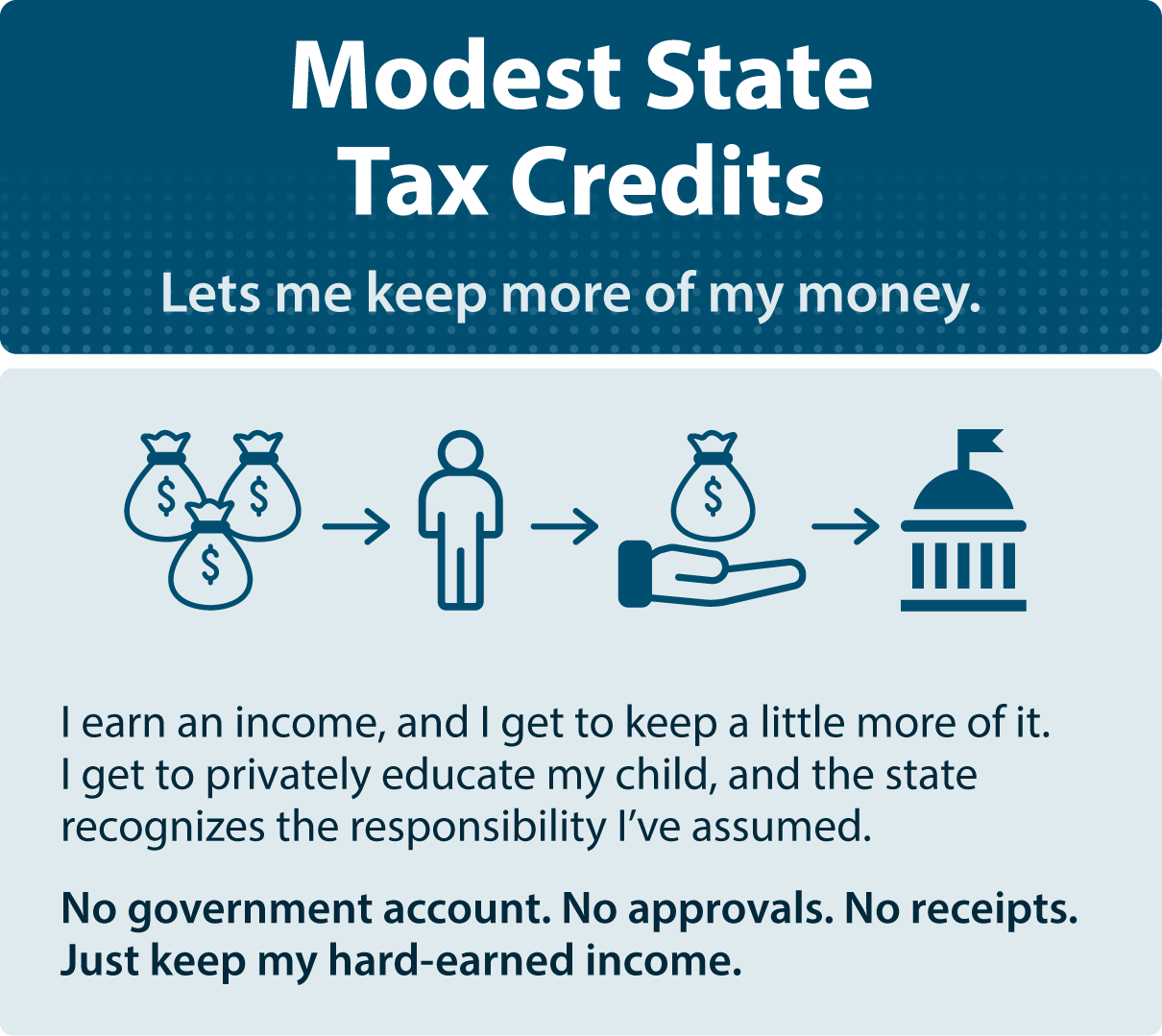
But not every tax benefit is an ESA. Take for example a modest, uncomplicated tax credit. In that 2017 speech, I made a distinction that I still think is important: A tax credit lets me keep more of my own money.
Imagine a state says this: If you are privately educating your child, check a box on your state income tax return and receive a $500 nonrefundable tax credit.
That's it.
No government education account. No approved curriculum list. No receipts. No reimbursement process. No bureaucrat deciding whether the math book you bought qualifies as an approved educational expense.
You privately educate your child, and the state says, in effect, “You're assuming responsibility for an education we otherwise might have to provide. Keep $500 of what you would otherwise owe us.”
We can support that kind of modest, uncomplicated tax relief.
Of course, legislators can call almost anything a “tax credit.” If a proposal creates accounts, approved expenses, reimbursements, and government supervision, calling it a tax credit doesn't make it a good proposal. Substance matters more than the label.
The devil, as they say, is in the details, and HSLDA analyzes every bill, no matter what it's called. So if you hear that HSLDA supports a particular tax credit bill, please confirm that we actually do support it by calling us or visiting our bill pages.
Our general support for an uncomplicated, modest tax credit has sometimes been portrayed as support for anything called a tax credit, and that just isn't true.
When Non-Profits Get Involved
Then there is the new Federal Scholarship Tax Credit (FSTC), which was passed as part of the One Big Beautiful Bill in 2025.
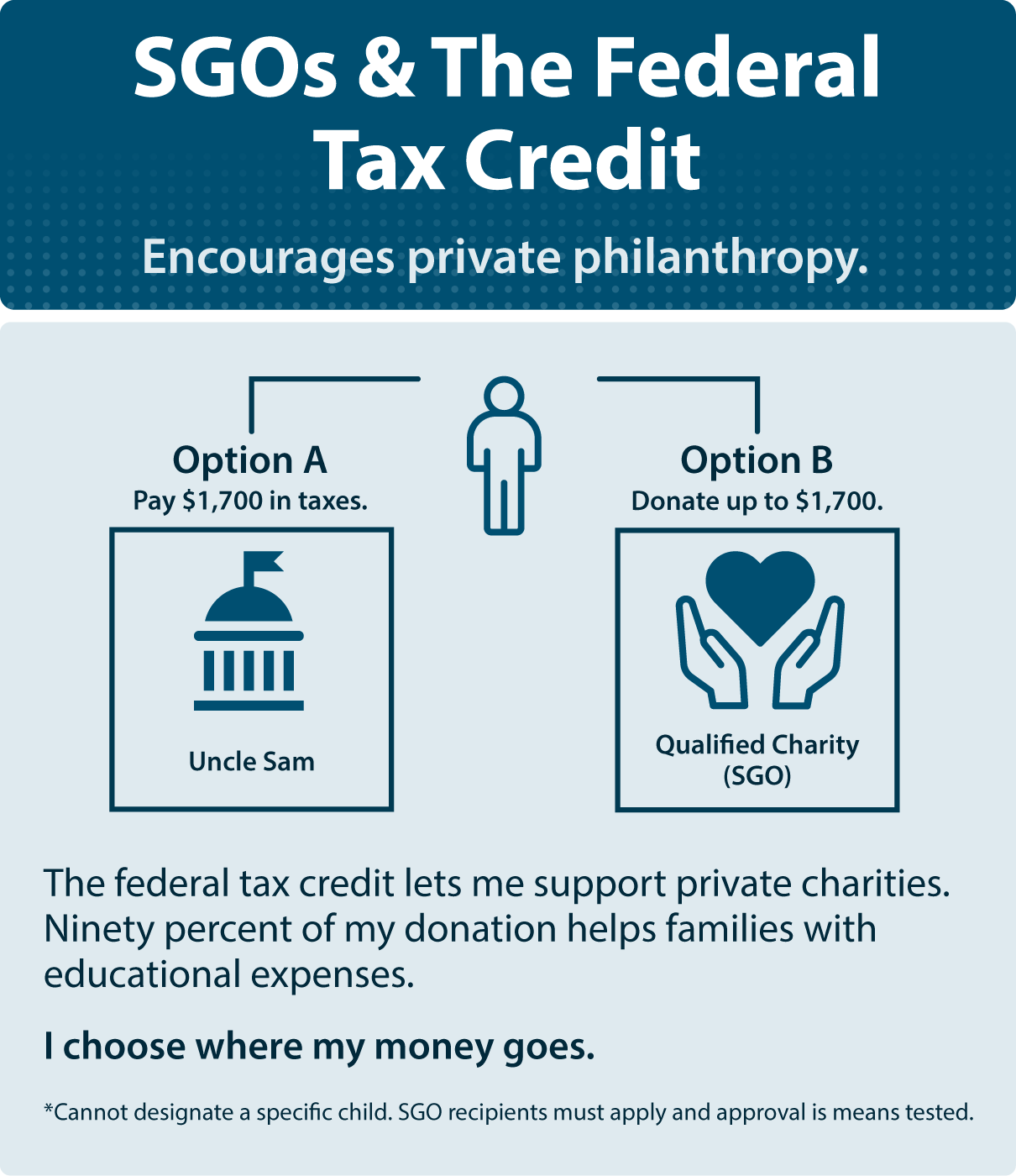
Beginning in 2027, taxpayers can give up to $1,700 to a qualified scholarship granting organization, or SGO, and receive a federal income tax credit for the donation. The SGO then uses those private donations to help eligible families with educational expenses.
Uncle Sam is saying, “You can pay that $1,700 to me, or you can donate it to a qualified charitable organization that helps families privately educate their children.”
When I lived in Oregon, there was a $100 political contribution tax credit. Debbie and I had a choice. Let Oregon have that money or contribute to Oregon Right to Life Political Committee. I’ll let you guess what we decided.
There are some important guardrails. An SGO must be a qualified nonprofit organization, and states must choose to participate in the federal program. Participating SGOs must use at least 90 percent of their income for scholarships.
Families apply to the SGO, not to the federal government, and the SGO determines eligibility based on means tests in the law. Scholarships are limited to students from households meeting the federal income requirements. Donors cannot simply direct their $1,700 gift to a particular child.
That isn't nearly as revolutionary as it may sound. HSLDA has been doing something remarkably similar for years through our Compassion program.
Generous donors give private money to HSLDA, a 501(c)(3) charitable organization. They receive a tax benefit for doing so. They may deduct the gift from their income when calculating their income tax. HSLDA determines which families qualify for assistance, and those charitable dollars go out to help those widows, disaster victims, and other families in need.
Many state homeschool organizations operate under the same basic tax structure. They are 501(c)(3) exempt organizations. They don’t have to pay income tax on the donations they receive, and their donors receive a tax benefit for supporting them.
Nobody seriously suggests that a donation to HSLDA or a state homeschool organization becomes “government money” because the donor gets a charitable deduction.
The FSTC operates differently Under this new federal program, donors to SGOs receive a dollar-for-dollar tax credit, up to $1,700.
Because Congress created this credit, Congress also established rules for creating an SGO and eligibility requirements for scholarship recipients. What it does not do is impose new federal regulations on how a family privately educates a child. Those differences matter.
We need to watch the implementation carefully. If the rules change in ways that threaten homeschool freedom, we'll say so. But for now, HSLDA supports this program.
Government involvement alone isn't the test. The tax code is involved in all three approaches. The better question is what kind of involvement, and what flows from it?
I come back to the question that matters most: What claim does accepting the benefit give government over the education of the child?
With ESAs, government collects and redistributes the money and controls permissible expenditures. With the simple tax credit, government forgoes some tax revenue and doesn't control the education. With the SGO, government creates a tax incentive and regulates eligibility for that incentive, but a private charity receives and distributes the money.
Those are distinctly different approaches. We should think about them differently.