

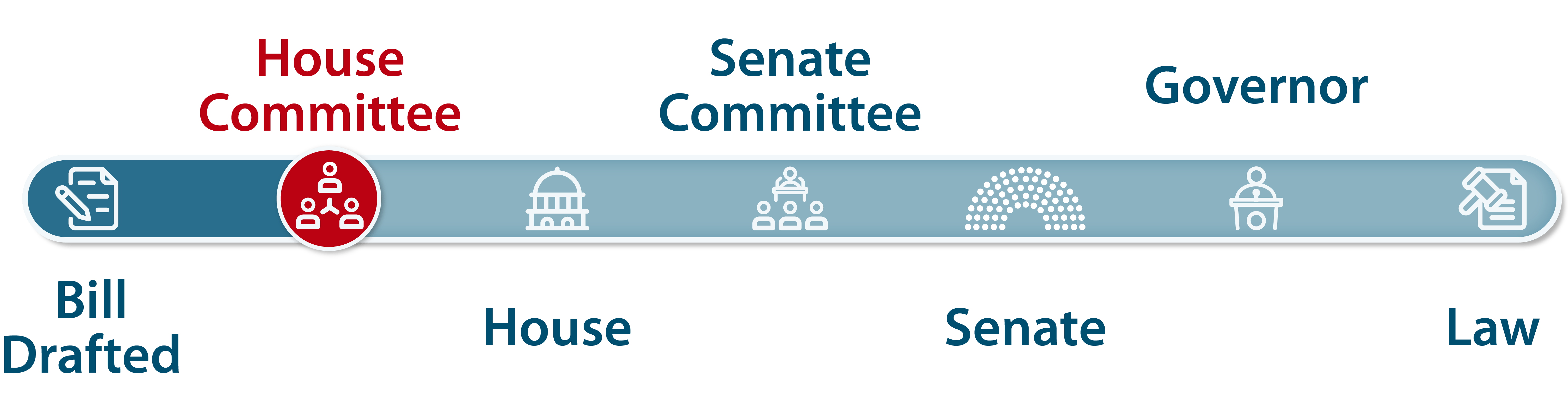
Latest Updates
June 11 | Bill Dies
Rhode Island's legislature closed, effectively killing this bill for this legislative season.
May 20 | Committee Hearing
The House Committee on Education voted to hold H. 8531 for further study even before testimony began during a hearing on May 19. Many people testified on the bill, including HSLDA Director of Litigation Peter Kamakawiwoole. Testimony on the bill lasted over two hours.
H. 8531 is still alive in the House Committee on Education, so please continue contacting members of that committee to let them know your opposition on the bill.
May 15 | Scheduled for a hearing before the House Education Committee
H. 8531 has been scheduled for a hearing before the House Education Committee at 4 p.m. on Tuesday, May 19.
Please contact members of the House Education Committee to ask them to oppose H. 8531, which poses major threats to the constitutional rights of parents to direct their children’s education. And if you are able, attend the hearing.
May 8 | Under Consideration in Committee
The House Education Committee is considering H. 8531. Please contact committee members and ask them to oppose this bill. The members of the House Education Committee are listed below
- Joseph M. McNamara
(401) 222-2296
rep-mcnamara@rilegislature.gov - Thomas E. Noret
(401) 222-4435
rep-noret@rilegislature.gov - Rebecca M. Kislak
(401) 222-2457
rep-kislak@rilegislature.gov - Nathan W. Biah
(401) 222-1224
rep-biah@rilegislature.gov - Julie A. Casimiro
(401) 222-4263
rep-casimiro@rilegislature.gov - Megan L. Cotter
(401) 222-1591
rep-cotter@rilegislature.gov - Susan R. Donovan
(401) 222-8028
rep-donovan@rilegislature.gov - Richard R. Fascia
(401) 222-2259
rep-fascia@rilegislature.gov - Joshua J. Giraldo
(401) 222-2447
rep-giraldo@rilegislature.gov - Ramon A. Perez
(401) 222-1725
rep-perez@rilegislature.gov - Robert D. Phillips
(401) 222-2457
rep-phillips@rilegislature.gov - Earl A. Read, III
(401) 222-2296
rep-read@rilegislature.gov - Sherry Roberts
(401) 222-2259
rep-roberts@rilegislature.gov - Mary Ann Shallcross Smith
(401) 222-1721
rep-shallcross-smith@rilegislature.gov - Brandon T. Voas
(401) 222-1224
rep-voas@rilegislature.gov
Summary of H.8531
For decades, families in Rhode Island have been able to homeschool by filing a simple notice with their local school committee, which then reviews the notice to objectively determine if the child will receive the instruction required by law.
H. 8531 would introduce subjectivity into that process by allowing school committees to deny or defer homeschooling if they believe approval would be “not in the best interest of the child.” The problem is that the “best interest of the child” standard was designed for a very different context: to settle disputes where two parents disagree about what is best for their own children. The United States Supreme Court has repeatedly warned in cases like Parham v. J.R. and Troxel v. Granville that the “best interest” standard is not the standard when a third party—such as a school committee—is challenging a fit parent’s decisions.
Moreover, the law presumes that fit parents are acting in their children’s best interests—not the other way around.
The bill would also require that a child already enrolled in public school must remain enrolled in public school while the committee decides whether to approve homeschooling (which can take up to 30 school days, with a potential 15-day extension). Almost four decades ago, the Supreme Judicial Court of Massachusetts held in Care and Protection of Charles that the state couldn’t force parents to keep their children enrolled in public school until homeschooling approval, without violating the family’s constitutional rights.
H.8531’s “trigger” provisions are also deeply flawed. Three of the four triggers relate to formal truancy or attendance proceedings: pending truancy petitions, petitions filed within the previous 12 months, or civil or criminal attendance-related charges. But the bill makes no distinction between allegations that were proven, those that are currently pending (where the accused is innocent until proven guilty), and where the parent prevailed in court.
The bill also flips the normal burden of proof upside down. Instead of requiring the district to prove its truancy allegations—or to show that it complied with existing attendance intervention requirements before filing a petition—the bill forces fit parents to prove their own “good faith,” “capacity,” and justification for homeschooling. In practice, families are treated as suspects first and forced to prove themselves innocent later.
Finally, the bill also allows the committee to deny or defer homeschooling whenever it concludes that the proposed instructor lacks “competency” or “capacity”—with no guidance or guardrails for making that determination—and provides only a limited administrative appeal process. If a school committee denies or defers homeschooling, the family’s only recourse is an appeal to the Department of Elementary and Secondary Education, whose decision is deemed “final,” with no clear opportunity for judicial review.