

Homeschool graduates are noted for giving back to the community. Caden Cartagena, a 12th-grader in California, began sharing the dividends of his home education years ago.
Caden was a homeschool high school freshman when a local Christian school accepted his proposal to teach students about the computer programming software he had been using to develop personal projects. That led to other volunteer teaching opportunities, and recently culminated in a request from a national education nonprofit to help instruct other teens as they prep for college entrance exams.
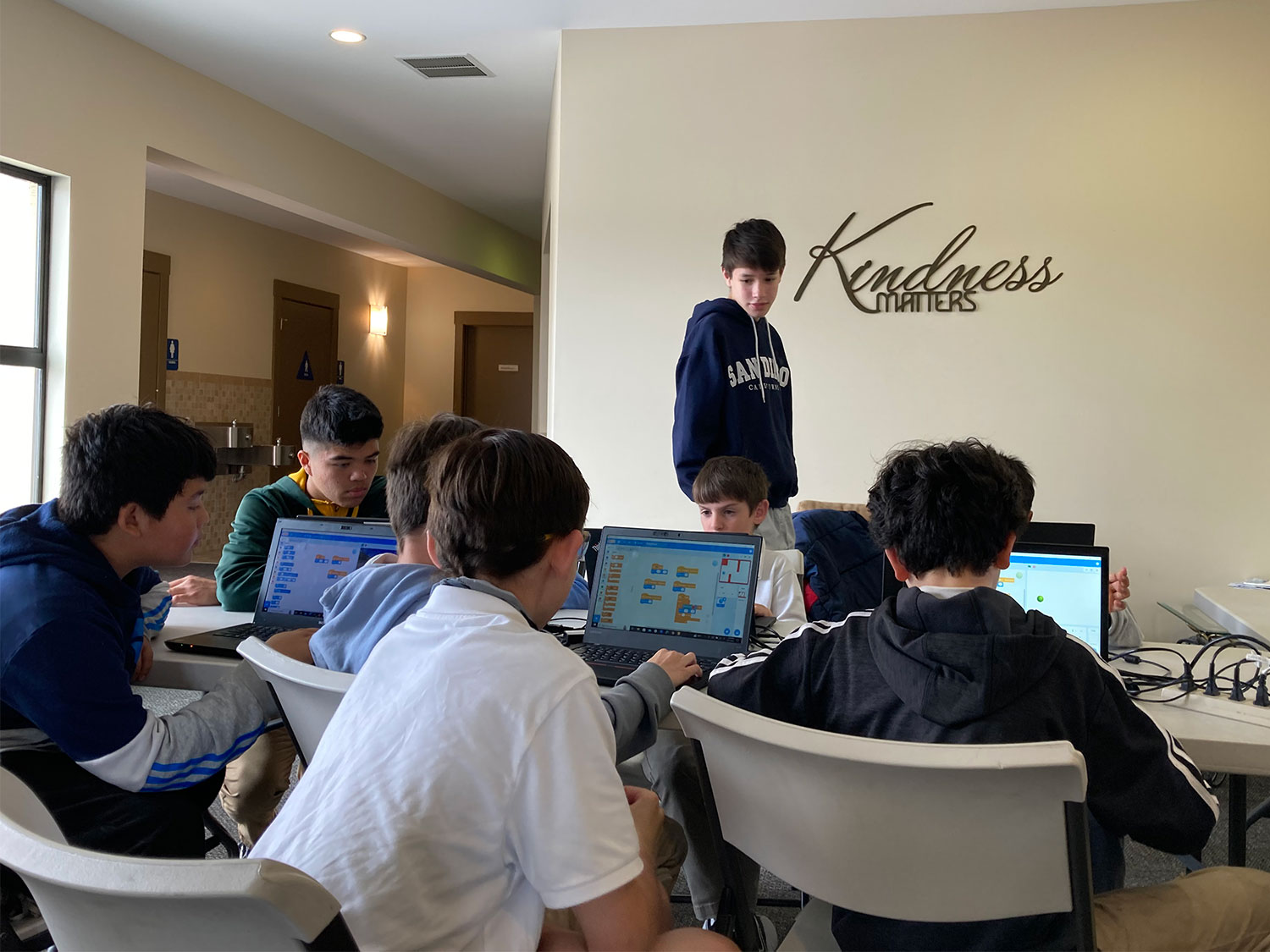
Caden teaching his first class at age 13
Now 17, Caden is narrowing down his options for college and a career. His parents Ed and Deanne Cartagena say that no matter where his career leads him, they already consider him a success based on the qualities he’s acquired and that others have noticed.
The principal of Shiloh United School’s Zechariah Campus, just one of the places where Caden has taught, described the teen in glowing terms. “The kids really loved and enjoyed their time with Caden,” he said. “Caden is a problem-solver, a leader, very intelligent, flexible, and creatively fun!”
Empowered to learn
Caden credits his early development as an instructor to his parents’ home education program.
“It allowed me to explore some of my own interests,” he said, adding that the flexibility of homeschooling gave him extra time to really immerse himself in the things he loves.
Like his older brother, who is studying biochemistry at Cornell University, Caden started homeschooling in kindergarten.
Deanne said she was inspired to begin home education after getting to know a family in her church who began homeschooling before her. From watching the family’s interaction, Deanne said she came to realize homeschooling is about much more than fulfilling basic educational requirements. It fosters faith, strengthens relationships, and engenders a love of learning.
“It has really brought us together as a family,” Deanne said.
She added that she was especially pleased to see how homeschooling promotes academic success by empowering students to take a certain amount of ownership in their own education.
“It’s not just school at home,” Deanne noted. “It teaches your children to self-govern. There’s so much self-study that they can delve in deep.”
Desire to teach
Caden’s self-motivation and confidence in expressing himself became apparent quickly.
At age 8 he took a class in Scratch, a visual programming language developed by the Massachusetts Institute of Technology. Caden then started spending 4–5 hours per week using Scratch to create games, including a digital target shooting simulation and a game that teaches students to recognize the flags of different countries. His projects drew about 1,000 online followers who were interested in the content he crafted.
Caden’s father Ed noted that Caden’s game designs impressed a friend who is a local business owner offering after school enrichment programs and summer camps.
“I showed him the games that Caden had developed,” Ed recalled, “and he told me the designs were better than some of the stuff done by college kids who were working for him. That was some nice validation.”
By age 13, Caden was ready to try in-person instruction. He compiled materials for an entire course in Scratch, including a full-fledged PowerPoint slide deck, and demonstrated it to the principal at Shiloh United.
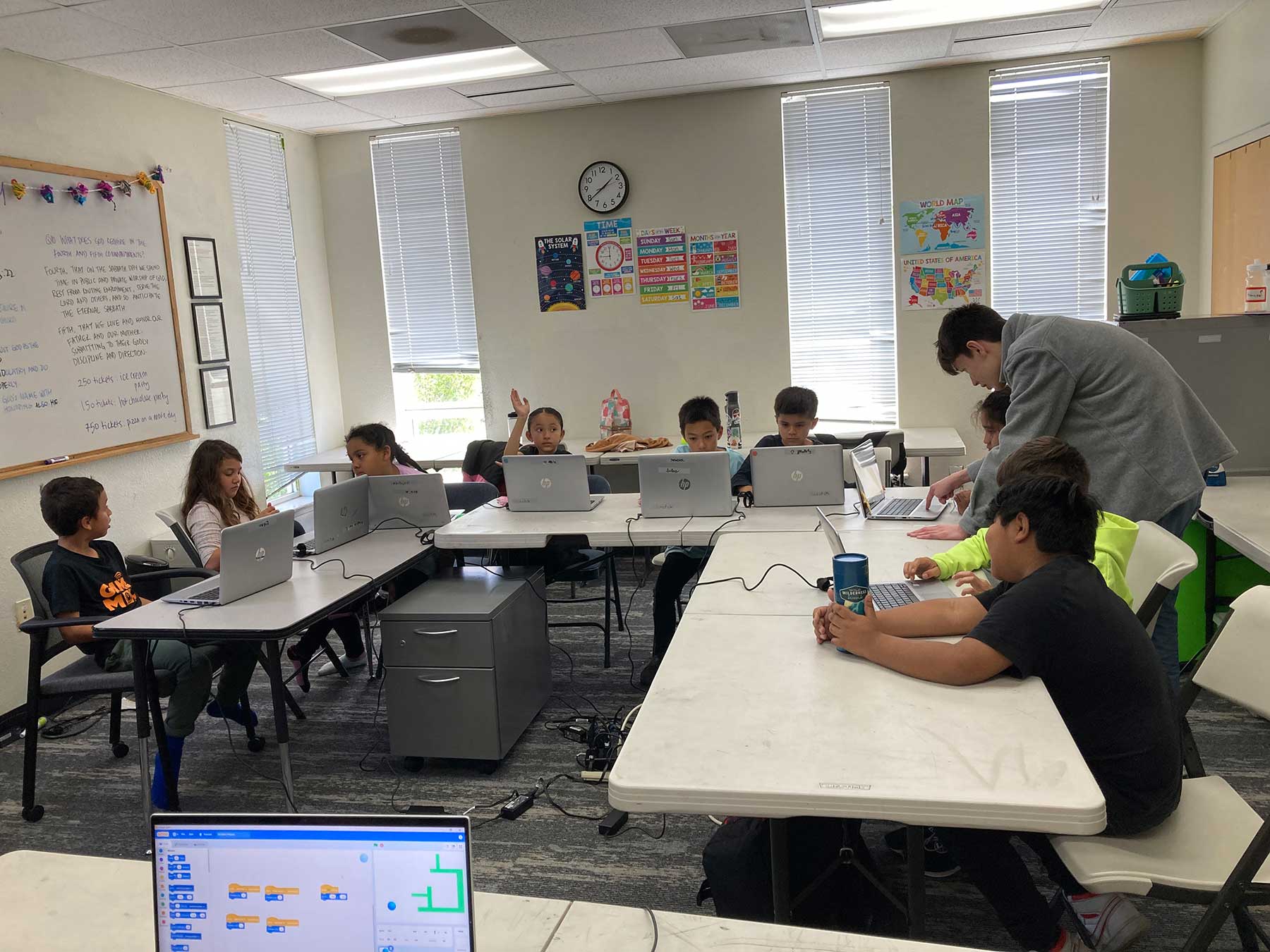
Caden helping his students during a class
After viewing it, school leaders invited Caden to teach his course to about dozen students in 4th grade through 6th grade. He held classes a few times per month. Each session involved more than just academic prep; Caden also ensured the laptop each student used had access to Scratch and other necessary tools.
Caden tried to emulate aspects of his own homeschooling experience by encouraging students to find programming projects that interested them instead of focusing on rote exercises.
“Seeing the kids enjoying what I was teaching was very fulfilling,” he said.
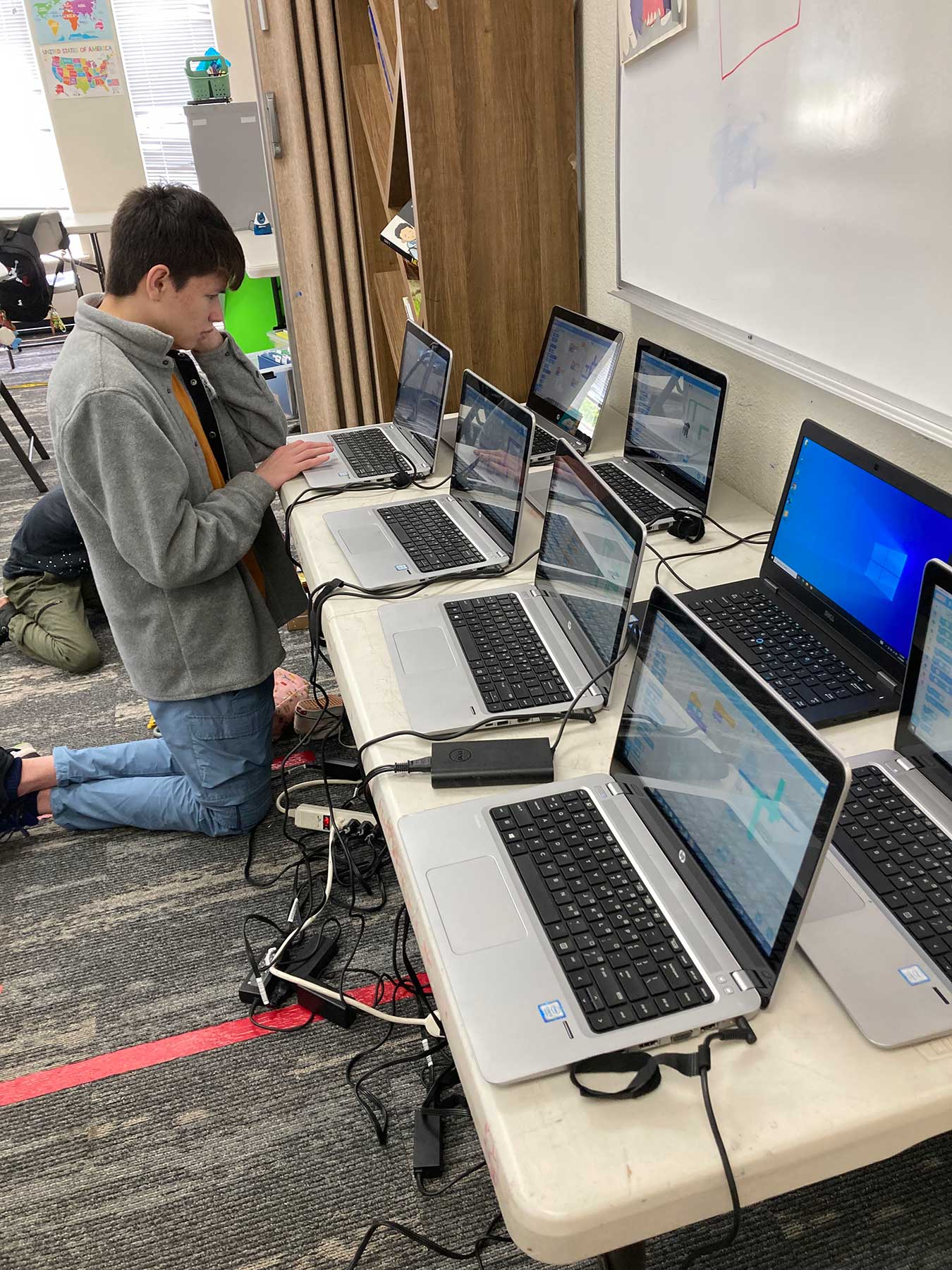
Caden setting up laptops for one of his classes
Another aspect of Caden’s volunteer work especially gratified his father. Most of the students the teen taught are from first-generation immigrant families, hailing from Latin America. Having moved with his parents from Brazil to the US when he was young, seeing his son cultivate kids with a similar history struck Ed as particularly poignant.
To the next level
Building on the success of his first course, Caden developed several others which he taught into his high school years. These included an advanced Scratch course, a geography course using a map game called GeoGuessr, and classes in one of Caden’s favorite activities—chess.
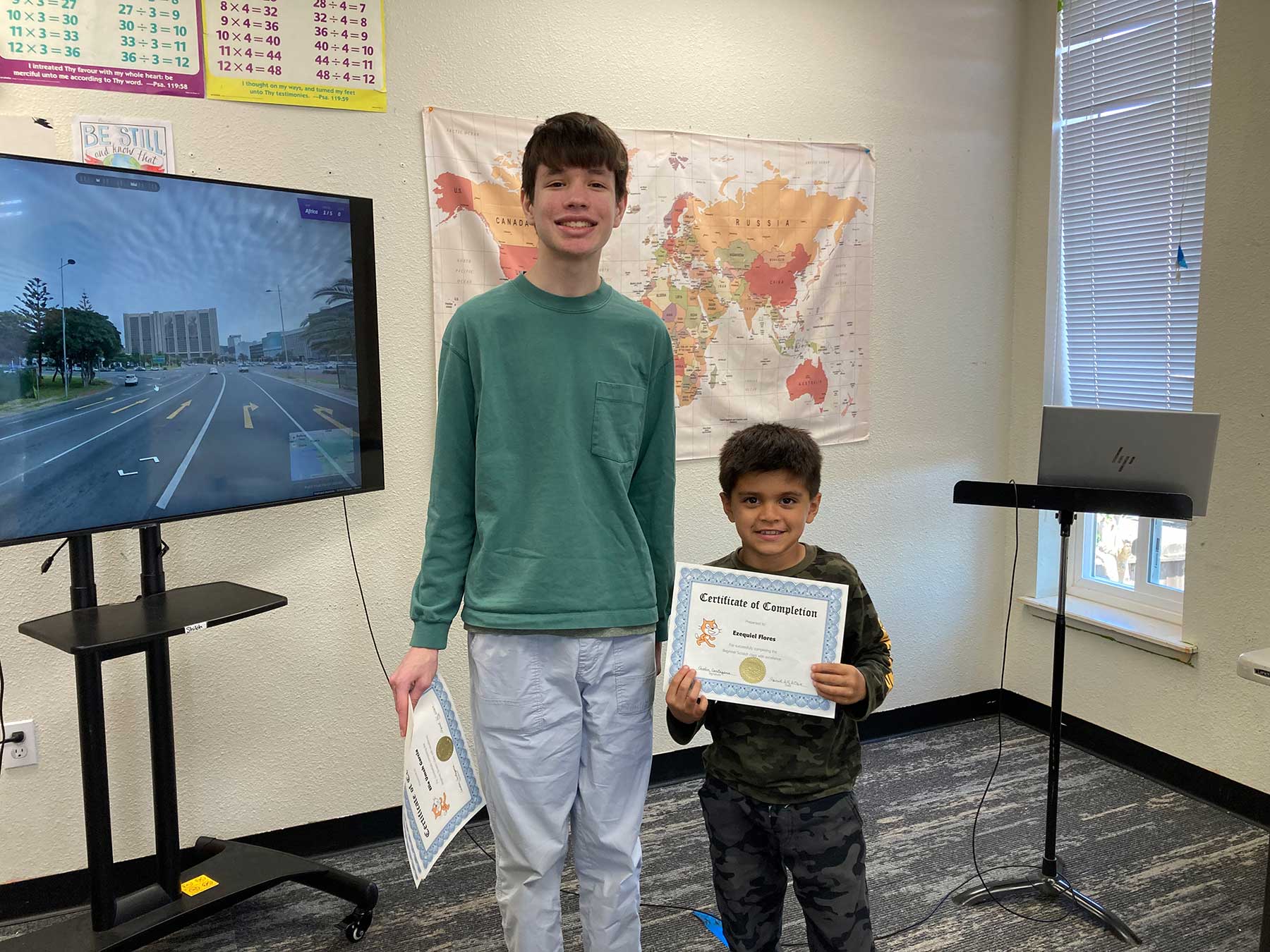
Caden awarding one of his students a Certificate of Completion
The teen said he is also working on a course to teach younger students how to navigate generative artificial intelligence.
“It’s inevitable they’re going to encounter AI,” Caden explained. “I want to show not only how to use it effectively, but safely and with academic integrity.”
He also had to find time to fulfill another obligation he accepted. After Caden took the SAT, and in response to his exceptionally high score he was contacted by the College Board, the organization that owns and administers the college entrance exam. They wanted to know if he would be willing to tutor other teens who are prepping for the test.
Caden quickly replied yes.
“That’s not something I want to pass up,” he said.
Since then, Caden has trained with an organization called Schoolhouse, which teamed up with the College Board to put on tutoring bootcamps. He personalized the content for each pupil, prepared additional resources, and followed up with them after the sessions were concluded. It’s all part of his commitment not just to share knowledge, but to inspire others.